


A certified translation of a power of attorney is a formally attested document that conveys the original legal authority of a power of attorney across language barriers for use in courts, government agencies, and financial institutions. Getting this wrong costs more than time. Rejected submissions, delayed settlements, and refused visa applications are the real consequences of an improperly translated or uncertified document. Whether you need to translate power of attorney documents for immigration, property transactions, or business dealings, the process follows a clear structure. This guide covers every step, from prerequisites to common pitfalls, so your document is accepted the first time.
What does certified translation of a power of attorney actually require?
Certified translation of a power of attorney is the process of converting a legal document from one language to another, accompanied by a formal declaration of accuracy signed by a qualified translator. The translation must mirror the original document precisely, including all legal clauses, party names, and powers granted. A signed declaration of accuracy is not optional. Without it, courts, USCIS, and Australian government agencies will reject the submission outright.
In Australia, the recognised standard for certified translators is NAATI accreditation. NAATI stands for the National Accreditation Authority for Translators and Interpreters. A NAATI-certified translator has demonstrated professional competency and is authorised to produce translations accepted by Australian courts, the Department of Home Affairs, and financial institutions. Outside Australia, bodies like the American Translators Association (ATA) serve a similar function for US submissions.
Before you commission any translation, you need three things in order:
- A valid, complete original document. The power of attorney must be signed, dated, and executed according to the laws of the issuing jurisdiction.
- Notarisation where required. Many receiving authorities require the original to be notarised before translation begins.
- An apostille or consular legalisation where applicable. If the document crosses international borders, apostille certification is often a separate requirement on top of certified translation.
| Item | Purpose | Who provides it |
|---|---|---|
| Original power of attorney | Source document for translation | Issuing party or solicitor |
| Notarisation | Verifies signatures and capacity | Notary public |
| Apostille or legalisation | Confirms document authenticity for foreign use | Government authority |
| Certified translation | Converts content with formal attestation | NAATI or ATA certified translator |
| Declaration of accuracy | Confirms translation faithfulness | Translator |
Pro Tip: Request a certified copy of the original power of attorney from your solicitor before submitting to a translation service. Translators work from the document you provide, and a poor-quality scan or incomplete copy will delay the entire process.
How to commission and receive a certified power of attorney translation
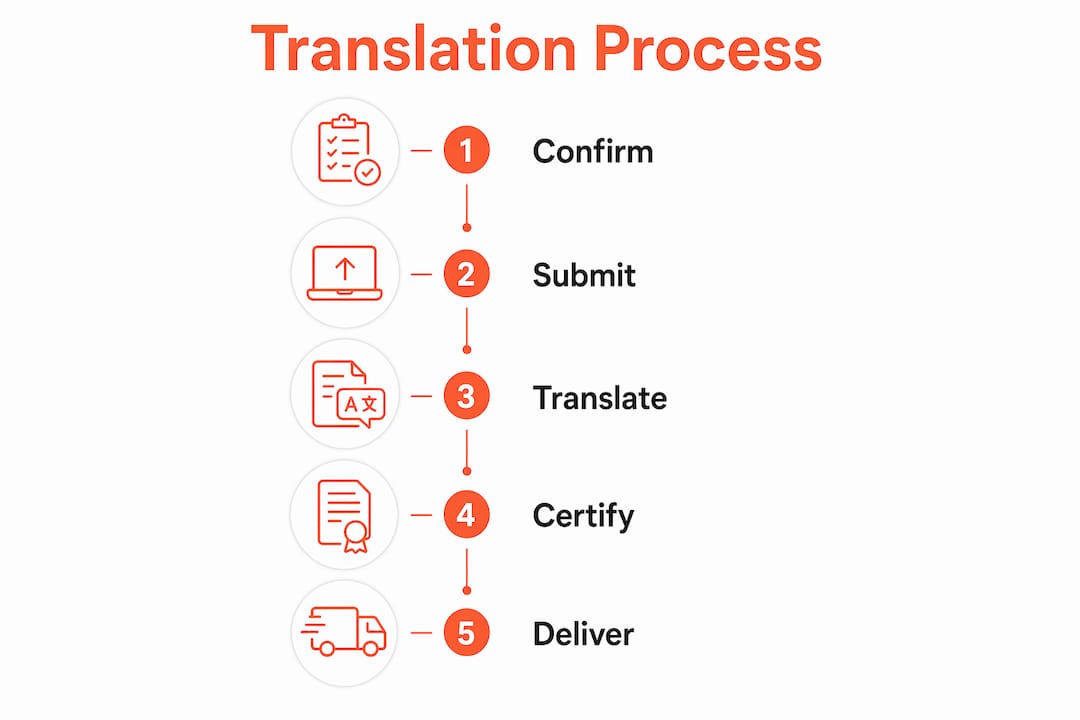
The process of obtaining an accepted certified translation follows a defined sequence. Skipping steps or reversing their order is the single most common cause of rejection.
- Confirm the receiving authority’s requirements. Contact the court, agency, or institution that will receive the document. Ask specifically whether they require NAATI certification, a notary seal on the translation, or an apostille on the original. Requirements vary significantly between Australian states, and between Australia and overseas jurisdictions.
- Select a qualified translation provider. Choose a provider whose translators hold NAATI accreditation for Australian submissions, or the appropriate national credential for overseas use. Legal document translation demands subject-matter expertise, not just language fluency. General translators routinely fail to render procedural legal terms accurately, which leads to rejection.
- Submit your original and supporting documents. Provide the complete original power of attorney, any notarisation certificates, and the apostille if already obtained. The translator needs the full document, not excerpts.
- Review the completed translation. Before accepting delivery, check that all party names, dates, and powers match the original exactly. Any discrepancy between the translation and the original document creates grounds for rejection.
- Receive the certified translation with declaration. The final document must include the translator’s signed declaration of accuracy, their NAATI credential number, and the date of certification. Some authorities also require the translation to be bound with the original.
| Step | Action | Typical timeframe |
|---|---|---|
| 1. Confirm requirements | Contact receiving authority | 1–3 business days |
| 2. Select provider | Verify NAATI or equivalent credentials | Same day |
| 3. Submit documents | Provide originals and supporting papers | Same day |
| 4. Translation completed | Provider translates and certifies | 24 hours standard |
| 5. Receive certified translation | Review and collect final document | Same day as completion |
Pricing for certified document services in 2026 typically falls between $29.00 and $40.00 per page, with standard turnaround within 24 hours and urgent four-hour options available for time-sensitive matters. That cost is minor compared to the expense of a rejected visa application or a delayed property settlement.

Pro Tip: If your matter is urgent, confirm the provider’s urgent turnaround in writing before submitting. Verbal assurances are not enforceable, and missed deadlines in legal proceedings carry real consequences.
How does notarisation interact with certified translation?
Notarisation and certified translation are separate processes that serve different functions. Confusing them is one of the most common client misunderstandings in legal document preparation, and it causes avoidable delays.
Notarisation is the act of a notary public verifying the identity of the person signing the power of attorney, confirming their mental capacity, and witnessing the signature. A notary does not translate anything. They authenticate the execution of the original document. Notaries are legally required to assess the principal’s mental capacity and voluntary action at the time of signing. If the principal lacked capacity, the power of attorney is invalid regardless of how well it is translated.
Certified translation makes the content of the document accessible in another language. It does not confer legal validity on the document itself. These are the key distinctions:
- Notarisation confirms the original document was properly executed.
- Certified translation confirms the content has been accurately rendered in another language.
- Apostille or consular legalisation confirms the document is authentic for use in a foreign jurisdiction.
All three may be required simultaneously, depending on where the document will be used. Over 90% of US jurisdictions require notarisation for powers of attorney to be accepted by financial institutions and government agencies. Australian requirements differ by state and by the nature of the transaction.
A certified translation makes a power of attorney readable across languages. Notarisation makes it legally executed. Apostille makes it internationally recognised. You often need all three, and none substitutes for the others.
Jurisdictional variation is significant. A power of attorney notarised in Queensland for use in Germany will require both an apostille issued by the Australian government and a certified translation into German. The same document used domestically in Queensland requires neither.
What common mistakes lead to rejected power of attorney translations?
Rejection is almost always avoidable. The mistakes that cause it are predictable and well-documented.
- Missing the declaration of accuracy. A translation without a formal signed attestation by the translator is inadmissible. This is the most frequent reason for rejection by courts and immigration authorities.
- Using a non-credentialled translator. General language professionals do not meet the standard for certified legal translation. NAATI accreditation in Australia, or an equivalent national credential elsewhere, is the minimum requirement.
- Ignoring apostille or legalisation requirements. Many applicants believe certified translation alone makes a foreign power of attorney legally binding in Australia or overseas. It does not. Apostille or consular authentication is a separate and often mandatory step for cross-border use.
- Submitting a stale document. Financial institutions apply staleness policies, rejecting powers of attorney older than 6–12 months or those lacking explicit authority for high-risk transactions. A correctly translated but outdated document will still be refused.
- Omitting specific powers. Banks and registries require explicit authority for transactions such as selling property, accessing superannuation, or managing investments. Vague or general powers are routinely rejected for these purposes.
- Providing incomplete documents. A full audit trail is required: the certified translation, the original document, and any apostille or notarisation certificates. Submitting only the translation is insufficient.
Pro Tip: Before submitting, ask the receiving authority for their specific checklist. Most courts, the Department of Home Affairs, and major banks have written requirements. Getting that list upfront eliminates guesswork and protects you from avoidable rejections.
Key takeaways
Certified translation of a power of attorney requires a NAATI-credentialled translator, a signed declaration of accuracy, and in most cross-border cases, notarisation and apostille certification as separate complementary steps.
| Point | Details |
|---|---|
| Certified translation is not legalisation | Translation makes content accessible; apostille or notarisation makes the document legally valid. |
| NAATI accreditation is the Australian standard | Only NAATI-certified translators produce translations accepted by Australian courts and government agencies. |
| Audit trail is mandatory | Submit the certified translation, original document, and apostille together for acceptance. |
| Staleness causes rejection | Financial institutions reject powers of attorney older than 6–12 months regardless of translation quality. |
| Specific powers must be stated | Vague authority clauses are refused by banks and registries for high-risk transactions. |
What I have learned from watching clients get this wrong
Working in this field, the pattern I see most often is not carelessness. It is misplaced confidence. Clients arrive with a translated document they paid for, only to discover the translator had no NAATI accreditation, the declaration of accuracy was missing, or the apostille was never obtained. The translation itself may be linguistically perfect. It still gets rejected.
The other thing I have observed is that people underestimate how jurisdiction-specific these requirements are. A process that works for a property transaction in New South Wales does not automatically apply to an immigration submission or a business transaction in Germany. The rules change depending on who is receiving the document and where.
My strongest recommendation is this: treat the receiving authority’s requirements as your starting point, not your finishing check. Contact them before you commission anything. Get their requirements in writing. Then choose a certified translator who understands the legal context of the document, not just the language. The difference between a translator who knows contract law terminology and one who does not shows up immediately in a legal review.
The audit trail matters more than most people realise. A signed declaration, a credential number, the original document, and the apostille together form the package that receiving authorities trust. Any missing element is grounds for rejection, and resubmission costs time and money that could have been avoided.
— David
How Certitranslate handles your power of attorney translation
Certitranslate provides certified translation services for power of attorney documents through a team of NAATI-accredited translators who specialise in legal and official documents. Every translation includes a signed declaration of accuracy and meets the standards required by Australian courts, the Department of Home Affairs, and financial institutions. Turnaround is 24 hours as standard, with urgent options available for time-sensitive matters. If you need a NAATI-certified translator for a power of attorney, a legal agreement, or any official document, Certitranslate delivers translations that are accepted without complication.
Preguntas frecuentes
What is a certified translation of a power of attorney?
A certified translation of a power of attorney is a formally attested translation of the original document, accompanied by a signed declaration of accuracy from a credentialled translator. In Australia, this means a NAATI-accredited translator must produce and sign the translation.
Does a certified translation replace notarisation?
No. Certified translation and notarisation are separate processes. Translation makes the document readable in another language; notarisation verifies the original was properly executed. Most cross-border submissions require both.
How much does power of attorney translation cost in Australia?
Certified translation services for power of attorney documents typically cost between $29.00 and $40.00 per page in 2026, with standard 24-hour turnaround and urgent four-hour options available from qualified providers.
When is an apostille required for a translated power of attorney?
An apostille is required when a power of attorney will be used in a foreign country that is a signatory to the Hague Convention. The apostille authenticates the original document for international use and is a separate step from certified translation.
What makes a certified translation inadmissible?
The most common reasons for rejection are a missing signed declaration of accuracy, use of a non-credentialled translator, an incomplete document package, or a power of attorney that is outdated under the receiving institution’s staleness policy.
Recommended
- CertiTranslate – Translations by NAATI Certified Translators
- United States – CertiTranslate – Translations by NAATI Certified Translators
- How to Choose the Right Certified Translator for Your Needs – CertiTranslate – Translations by NAATI Certified Translators